
Imagine climbing a flight of stairs without needing to pull yourself up with the handrail. Or getting up from a low, comfortable couch with ease. This isn't just a nice thought—it’s the direct result of building specific, targeted strength in your legs.
The primary leg extension benefits for adults over 50 aren't about aesthetics; they're about building the quadriceps strength you need for real-life independence.
Why Leg Extensions Are a Game Changer After 50
For many folks, the idea of strength training can feel a bit daunting, especially after 50. But what if one straightforward, controlled exercise could dramatically improve how you move through your day?
That’s exactly where the leg extension machine comes in. It’s a powerful tool for unlocking a more active, capable, and confident life.
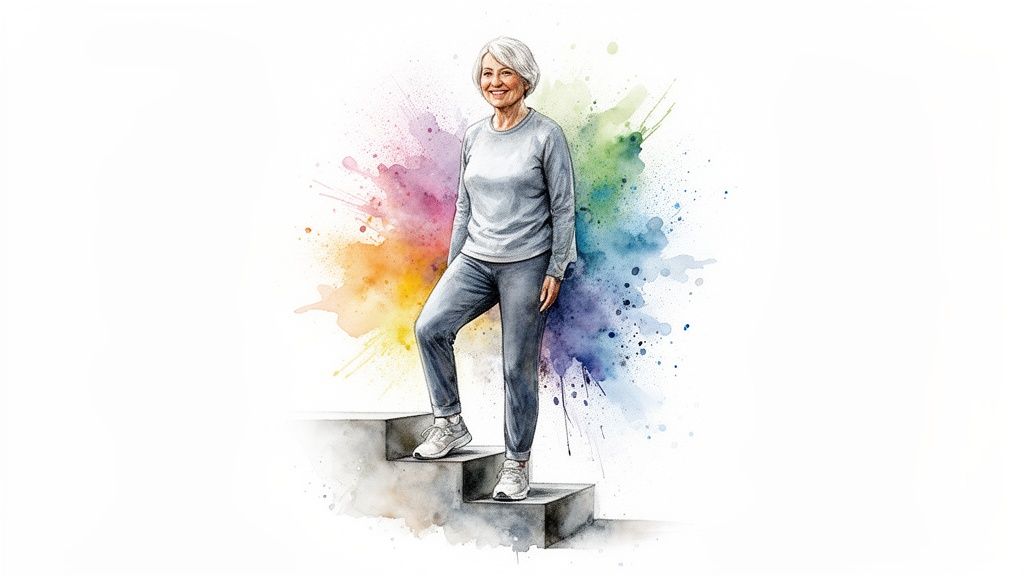
This guide gets right to the point: strengthening your quadriceps—the large muscles on the front of your thighs—is a cornerstone of staying mobile and independent as you age. Let's dig into how these muscles directly impact your daily life and long-term health.
The Engine for Everyday Movement
Think of your quads as the main engine for most of your lower body movements. They’re the muscles you rely on every single day for crucial tasks.
They are essential for:
- Standing up from a chair: That simple act of getting up relies almost entirely on quad strength to lift your body.
- Climbing stairs: Each step you take is like a mini-repetition, requiring your quads to propel you upward against gravity.
- Walking and staying balanced: Strong quads help stabilize your knee joint, which is absolutely critical for preventing falls, especially on uneven sidewalks or grassy park lawns.
By isolating and strengthening these muscles directly, leg extensions improve your ability to handle these essential tasks. This targeted work builds a solid foundation for all other movements, a key concept we cover in our guide on what is functional strength training.
The goal isn't just to move a weight pad in the gym. It's to build strength that shows up in your life, making daily activities feel easier and safer with every repetition.
For a quick overview, this table breaks down how leg extensions can directly impact your daily life.
Key Leg Extension Benefits at a Glance
| Benefit | Impact on Daily Life | Who It Helps Most |
|---|---|---|
| Increased Quad Strength | Makes getting up from low chairs, couches, or toilets noticeably easier. | Anyone who feels they need to "push off" with their hands to stand up. |
| Improved Knee Extension Power | Provides the "oomph" needed to climb stairs and walk up inclines without feeling winded or unstable. | Individuals who avoid stairs or find them challenging. |
| Enhanced Knee Stability | Helps create a more stable, trustworthy knee joint, reducing the risk of wobbles or giving way. | People concerned about balance and fall prevention, especially on uneven ground. |
| Functional Transfer | Builds strength that directly translates to walking with more confidence and endurance. | Adults who want to maintain an active lifestyle, from walking the dog to traveling. |
In short, this single exercise helps reinforce the very movements that keep you independent and engaged with the world around you.
A Focus on Safe, Guided Training
Throughout this guide, we're going to put safety first. I can't stress this enough.
When done correctly, especially with an expert’s guidance, the leg extension is an incredibly effective and low-impact exercise. A focus on proper form ensures you build strength sustainably without putting unnecessary stress on your joints. It’s all about working smarter, not just harder, so every movement contributes positively to your long-term health.
Building Your Foundation With Quadriceps Strength
Think of your quadriceps—the big muscles on the front of your thighs—as the engine that powers your daily life. They’re what get you out of a low chair, push you up a flight of stairs, and provide the horsepower for almost every move you make. The real benefit of the leg extension machine comes from its unique ability to isolate and strengthen this crucial engine.
Unlike an exercise like a squat, which demands a lot of balance and coordination from your entire body, the leg extension lets you zero in on just one thing: building stronger quads. This makes it a fantastic tool, especially if you’re just getting back into a routine or need to work around other sensitive joints. It offers a direct, uncomplicated path to strengthening the very muscles that support your knees and power your mobility.
Tuning Up Your Engine for Real Life
Targeting your quads with leg extensions is like giving that engine a much-needed tune-up. When your quads are strong, they take a tremendous amount of strain off your knee joints. Suddenly, you have more power for all those functional, everyday tasks.
This focused strengthening pays off directly in how you move through your day and can even reduce your risk of falls. In fact, the research is pretty clear on this. Studies show that even a small 9%-10% improvement in leg-extensor power can make a huge difference in mobility for older adults. Some research has even found that doing lower body exercises just twice a week can boost leg-extensor power by an incredible 34%-40% in seniors with limited mobility. That’s a life-changing gain for everyday independence. You can read the full research about these mobility findings on ncbi.nlm.nih.gov.
This isn’t just about building muscle for the sake of it. It’s about building the physical capacity you need to live your life confidently and without having to second-guess your body. Each good repetition is a direct deposit into your stability and independence account.
When you add this exercise to your routine, you're making a direct investment in your ability to move safely and freely for years to come. The strength you build here is the strength that shows up when you’re navigating an unfamiliar city on vacation or just carrying groceries in from the car. This is why focusing on quality over quantity is so important, which is a core part of what we call a "working set." You can learn more about what is a working set in our detailed guide.
The Link Between Strong Quads and a Longer Life
It might sound surprising, but the strength of your legs—specifically your quadriceps—is one of the most powerful predictors of how long and how well you’ll live. This isn't just about making stairs easier. We’re talking about a direct, scientifically-backed connection between quad strength and longevity.
In study after study, researchers have found that stronger quads are linked to a lower risk of all-cause mortality, even in otherwise healthy adults. Put simply, strong legs aren't just for getting around; they're a key marker of your future health.
Firing Up Your Metabolic Furnace
Think of your quads as your body's metabolic furnace. As one of the largest muscle groups, training them requires a tremendous amount of energy. When you do an exercise like the leg extension, you’re stoking that furnace.
The result is a significant boost in your metabolism that lasts long after your workout is over. For anyone trying to manage their weight after 50, this is a huge advantage. It's one of the reasons we say every single rep is an investment in your future. As these longevity findings from discoverstrength.com show, building these muscles is a proactive strategy for a healthier life.
Strong quadriceps do more than just help you stand up from a chair; they actively contribute to your metabolic health and are a proactive tool for living a longer, more independent life.
This strength is a cornerstone of overall wellness. For example, strong quads help stabilize your knees, which is essential for the activities we outline in our guide to balance exercises for seniors at home.
A Smarter, Safer Way to Build Total Leg Strength
Here’s where the leg extension really shines for adults over 50. One of its most practical benefits is how it makes other big leg exercises safer and more effective.
By doing your leg extensions before a compound exercise like the leg press, you strategically pre-fatigue your quads. This technique, called pre-exhaustion, is a game-changer. It means you can get the same muscle-building stimulus from your leg press while using significantly less weight—often up to 40% less.
This is a huge win for joint health. You get all the benefits of a challenging workout with far less stress on your knees, hips, and lower back, making your entire routine safer and more sustainable for the long haul.
Smart Techniques For Maximum Results and Joint Safety
Performing the leg extension correctly is what separates a fantastic quad-builder from a knee-aggravator. It might look like a simple up-and-down motion, but tiny adjustments in your technique make a world of difference for both safety and muscle growth.
Think of it less as just lifting weight and more as a controlled, deliberate contraction of your thigh muscles. To really unlock this exercise, how you position your body matters more than you might think. A simple tweak to the back-pad can lead to surprisingly better results.
The Power of The Reclined Position
Recent research has uncovered a powerful technique to get significantly more out of your leg extensions. This isn’t just a minor tip; it’s a way to unlock greater muscle growth from the exact same exercise.
Think of it like stretching a rubber band before you snap it. By performing the leg extension with the seat-back reclined, you put one of your four quad muscles—the rectus femoris—into a more lengthened, or stretched, state at the hip. This "pre-stretch" allows for a much more forceful contraction and greater muscle activation.
A groundbreaking 2023 study confirmed this. The research found that performing leg extensions while reclined at about 40° led to a massive 15.8% increase in lower quad thickness and 12.4% in upper quad thickness. These results crushed the upright seated version. It's a perfect example of how a simple change in position can lead to superior results. You can read more about these impressive leg extension findings on menshealth.com.
Essential Coaching Cues for Every Rep
Beyond your setup, how you perform each repetition is key. Rushing the motion or using momentum robs you of the benefits and puts unnecessary stress on your joints.
For every single rep, focus on these critical coaching cues:
- Control the Negative: Don't just let the weight drop. Lower the pad slowly and deliberately, taking at least two to three seconds. This lowering (eccentric) phase is where much of the muscle strengthening and stabilization happens.
- Squeeze at the Top: At the very top of the extension, actively squeeze your quads for a full second. This ensures you're engaging the muscles that stabilize your kneecap—a huge win for long-term joint health.
- Avoid Locking Your Knees: Extend your legs until they are straight, but never forcefully locked out. Keeping a "soft" knee at the top protects the joint from hyperextension.
This infographic shows the direct link between building stronger quads and improving key markers for longevity.
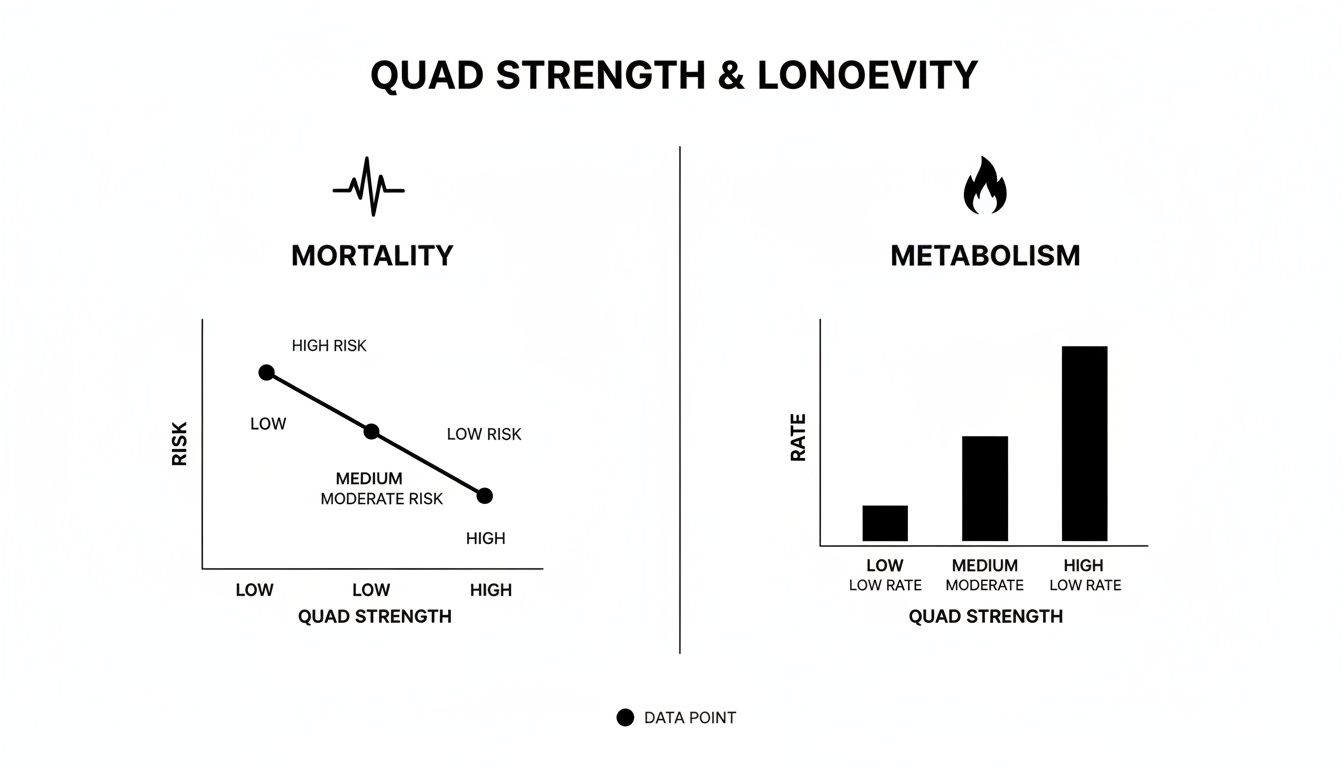
The data is clear: as quadriceps strength goes up, markers for mortality risk go down while metabolic health improves. With the right guidance, you can turn a basic machine exercise into a highly effective—and safe—tool for building life-enhancing strength.
Of course. Here is the rewritten section, following all your specified requirements for tone, style, and formatting.
Integrating Leg Extensions Into Your Fitness Plan
Knowing the "why" behind an exercise is one thing, but knowing how to weave it into your week is where you'll see real progress. The good news is that adding leg extensions to your routine is simple and flexible, whether you're in a fully equipped gym or working from your living room.
For most adults over 50, a great place to start is performing leg extensions 1-2 times per week. The key is to schedule them on non-consecutive days. This gives your muscles the downtime they absolutely need to recover, adapt, and grow stronger.
Finding Your Ideal Sets and Reps
With this exercise, your focus should always be on control and quality, not just moving the heaviest weight you can. A solid starting point is to aim for 2-3 sets of 10-15 repetitions.
The weight you choose should feel challenging by those last few reps, but not so heavy that your form breaks down. You should be able to move slowly and with intention, especially on the way down. That controlled lowering motion is where so many of the joint stability benefits come from.
The goal isn’t exhaustion; it’s effective stimulation. Each controlled repetition is a direct investment in your quad strength and, by extension, your daily stability and confidence.
A Smarter Strategy: The Pre-Exhaust Method
One of the most effective ways I use leg extensions with clients is a technique called pre-exhaustion. It sounds fancy, but the concept is simple: you perform your leg extension sets before a bigger, compound movement like a leg press or a squat variation.
By tiring out your quadriceps first, you force them to work much harder during the main exercise that follows, even if you're using a lighter weight. This is a huge win for joint safety, as it lets you get a fantastic muscle-building workout with far less strain on your knees, hips, and lower back.
Machine Vs. Band: Which is Right for You?
No leg extension machine in your building's gym? No problem at all. Resistance bands are an excellent, accessible alternative that can deliver great results. It's helpful to understand what each tool brings to the table.
Machine Leg Extensions Vs. Resistance Band Alternatives
| Feature | Machine Leg Extension | Resistance Band Knee Extension |
|---|---|---|
| Resistance Profile | Provides consistent tension through the entire range of motion. | Resistance increases as the band stretches, peaking at the top of the extension. |
| Accessibility | Requires access to a specific piece of gym equipment. | Highly portable, inexpensive, and can be done anywhere with a sturdy chair. |
| Best For | Precisely isolating the quads and tracking progressive overload with exact weights. | Home workouts, travel, or as a low-impact option to build foundational strength. |
At the end of the day, whether you use a machine or a band, the secret ingredient is consistency. A well-designed plan, tailored to your goals and the equipment you have, is your roadmap to building stronger legs and enjoying a more active, independent life.
Frequently Asked Questions About Leg Extensions
It’s completely normal to have questions when you’re considering a new exercise, especially one like the leg extension that gets a lot of mixed press online.
Let's cut through the noise and talk about what really matters. Here are a few of the most common questions we get from clients, with straightforward, experience-backed answers.
Are Leg Extensions Bad For Your Knees?
This is the number one question we hear, and it's a fair one. The idea that leg extensions are automatically “bad for the knees” is one of the most persistent myths in the gym, but it’s just not true when they’re done right.
In fact, physical therapists use this exact same movement to help people rebuild knee strength after injury or surgery. It’s a tool. The secret is how you use it.
When you use a controlled weight, move smoothly without kicking, and stop just short of locking your knee at the top, the exercise is incredibly safe. It builds up the quadriceps muscles, which are your body’s natural shock absorbers for the knee joint. A good coach ensures your form is spot-on, turning this into one of the best joint-friendly exercises you can do.
How Often Should I Do Leg Extensions?
When it comes to building strength after 50, more is definitely not better. Consistency is what counts.
For most people, adding leg extensions to your routine 1 to 2 times per week is the sweet spot. This gives your muscles the signal they need to get stronger without running you into the ground.
Remember, the real strength-building happens during recovery. Giving your muscles at least a full day or two to rest and repair between sessions is non-negotiable. It’s all about the quality of the work, not the quantity of workouts.
Can I Get The Same Benefits From Squats?
Squats and lunges are fantastic exercises, no doubt. But they are also compound movements, meaning they ask a lot from your hips, back, and ankles all at once. Leg extensions offer a unique benefit that squats can't match: isolation.
Isolation lets you put all of your focus and energy directly into the quadriceps without needing great balance or putting stress on other joints.
This is a game-changer if you’re working around sensitive hips, a touchy lower back, or ankle limitations. It's also perfect if you just want to give your quads that extra targeted work they need. A smart program often includes both, using the leg extension as the go-to tool for pure, focused quad strength.
What If I Don't Have Access To a Machine?
No machine? No problem at all. You can get many of the same benefits right at home with a simple resistance band. It's a fantastic, low-impact option that targets the exact same muscles.
All you have to do is sit tall on a sturdy chair, loop one end of a resistance band around your ankle, and secure the other end to one of the chair’s front legs. From there, just extend your leg out slowly and smoothly, feeling the tension from the band. Squeeze your quad at the top for a second, then control the movement all the way back down.
Here is the rewritten section, following all the provided instructions and examples.
Your Path to Stronger Legs and Better Balance
So, what does all this mean for you? When you break it down, the benefits of the leg extension aren't just about building muscle—they’re about building a more capable, confident life.
We're talking about stronger quads that power you up a flight of stairs, better balance that lets you navigate a crowded sidewalk without a second thought, and the kind of daily mobility that keeps you independent and in control.
Each slow, controlled rep is a deposit into your future. It's the strength that makes getting up from a low sofa feel easy, not like a chore. It's building a body you can truly rely on.
Turning Knowledge Into Action
Whether you're using the leg extension machine in your building’s gym or a simple resistance band at home doesn't really matter. What matters is doing it consistently and, most importantly, safely.
You now have the roadmap. The key is to focus on that slow, deliberate movement. This protects your joints while making sure the muscle is doing all the work. It’s not about speed; it’s about control.
I encourage you to start weaving this simple exercise into your weekly plan. There’s no better way to see the difference it makes than to feel it for yourself. This is your chance to build the functional strength you need for the life you want—one good repetition at a time.
When you focus on a fundamental movement like this, you aren't just exercising. You're making a direct investment in a future with more freedom, less hesitation, and real physical confidence.
Start small. Nail the form first. Be patient. The journey to stronger legs and better balance begins with that very first, intentional lift. The strength you build today is the stability that carries you for years to come. Your path to a more capable you starts right now.
Ready to build the strength you need for real life with an expert guiding you every step of the way? Prime Vitality 50+ brings private, personalized training directly to your residential gym in Streeterville. Learn more and schedule your complimentary consultation at https://primevitality50plus.com.