In resistance training, you'll often hear trainers talk about working sets. These are the heart of your workout—the sets that actually challenge your muscles enough to spark real, meaningful change.
Think of them as the main course of your fitness meal. They’re where all the good stuff happens: progress in strength, better balance, and stronger bones.
What Is a Working Set and Why Does It Matter
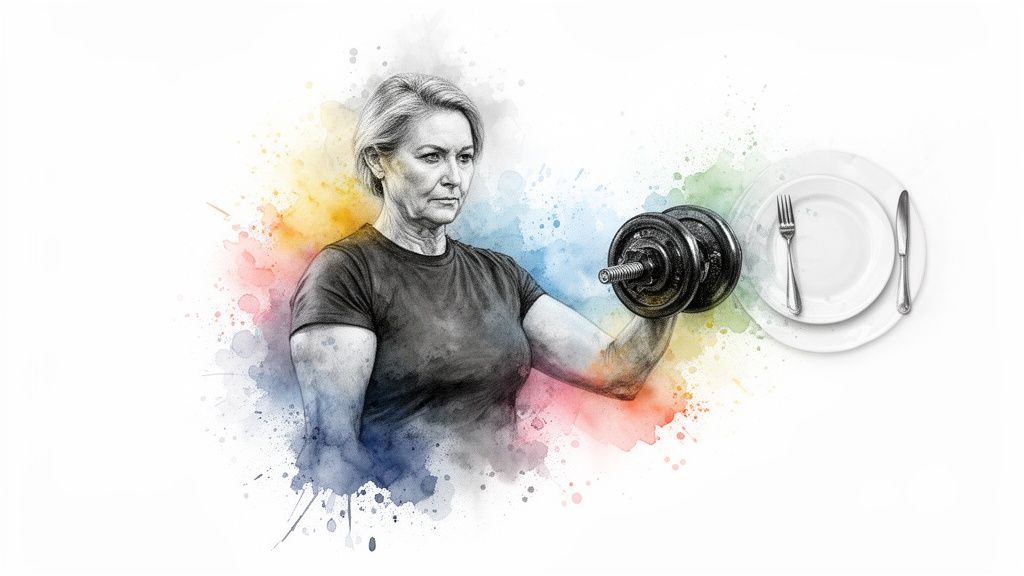
Let's stick with that meal analogy for a moment. If your workout were a nice dinner, your warm-up would be the appetizer—light, simple, and meant to get you ready for what’s next. Your cool-down is like a relaxing dessert.
The working set, however, is the nutrient-dense main course. This is where you use a weight that’s genuinely challenging, stimulating your body to adapt and come back stronger.
Without that focused effort, you’re just going through the motions. And while any movement is better than none, it’s the working set that provides the specific signal your body needs for:
- Building Real Strength: The tension from a tough (but doable) set tells your muscles they need to repair and grow. This is how strength is built.
- Improving Bone Density: Your bones are living tissue. When you load them with resistance, they respond by becoming denser and more resilient—a crucial defense against fractures.
- Boosting Functional Fitness: This is the strength that matters most in daily life. It’s what helps you carry groceries with ease, get up from a low chair, or lift a grandchild without a second thought.
The Purpose of Each Set
The one thing that defines a working set is intensity. It’s not about mindlessly lifting a weight; it’s about choosing a weight that feels difficult, especially on those last few repetitions, all while keeping your form perfect. That distinction is the key to getting results without getting hurt.
To make it even clearer, let’s break down the different types of sets you’ll find in a well-designed workout. This is exactly how our trainers at Prime Vitality 50+ structure sessions to make sure every minute is productive and safe.
Your Workout Sets at a Glance
Here’s a quick look at the role each set plays in your workout.
| Set Type | Purpose | Intensity Level | Example Reps |
|---|---|---|---|
| Warm-Up Set | Prepares muscles and joints; rehearses the movement pattern. | Very Light (30-50%) | 10-15 reps |
| Working Set | Stimulates muscle growth, strength gains, and bone density. | Challenging (70-85%) | 6-12 reps |
| Cool-Down | Promotes recovery and helps improve flexibility. | Very Low (Stretching) | N/A (Timed holds) |
Understanding these differences helps you see why just showing up isn’t enough. It’s the quality and intent behind your sets that drive your progress forward.
Warm-Up Sets vs. Working Sets: Preparation vs. Performance

One of the most common mistakes I see in the gym is people confusing preparation with performance. It’s an easy trap to fall into, but understanding the difference is key to getting real results without getting hurt.
Think of it this way: your warm-up sets are the dress rehearsal. They’re your chance to practice the movements, check in with your body, and get everything ready for the main event.
Your working sets? That’s opening night. It’s where the real work—and the real progress—happens.
What a Warm-Up Set Really Does
The goal of a warm-up set is simple: get your body ready for a specific exercise without making you tired.
You’re not trying to build muscle here. You’re just waking everything up. This means using a much lighter weight—or even just your bodyweight—for a handful of smooth, controlled repetitions. For a Goblet Squat, your warm-up might be a set of bodyweight squats or a few reps holding a very light kettlebell.
A proper warm-up does three critical things:
- It warms the muscles. Think of it like letting a car's engine warm up on a cold morning. Warm muscles are more pliable, efficient, and far less prone to injury.
- It lubricates the joints. Movement encourages the production of synovial fluid, which is your body's natural joint lubricant. This is non-negotiable for healthy knees, hips, and shoulders.
- It grooves the pattern. Each warm-up rep is a chance to rehearse perfect form. You’re reminding your brain and body how the movement should feel before you add challenging weight.
For adults over 50, this isn't optional. It's your first and best line of defense against aches, pains, and setbacks.
Making the Shift to a Working Set
Once you’ve done a warm-up set or two, it’s time to transition. This is when you pick up a weight that’s genuinely challenging. This is your working set.
The weight should be heavy enough that the last 2-3 reps of your set are difficult, but not so heavy that your form gets sloppy. You should always feel in control.
A working set is the signal that tells your body, “We need to get stronger to handle this.” That signal is what builds lean muscle, supports bone density, and ultimately makes daily life feel easier.
Warm-ups are about safety and readiness. Working sets are about building strength and capacity.
At Prime Vitality 50+, our trainers live by this distinction. We guide you through the rehearsal so you can perform your best when it counts—safely and effectively.
Finding the Right Intensity for Your Working Sets
Intensity is the key ingredient that turns a regular set into a working set—the kind that actually builds meaningful strength and resilience. But how do you know if you’re working hard enough?
Forget the complicated percentages and calculators. The best tool you have is your own body. We use a simple, powerful tool called the Rate of Perceived Exertion (RPE) scale to measure it.
Think of it as a 1 to 10 effort scale. A 1 is as easy as sitting on the couch. A 10 is an all-out, maximum-effort lift where you physically could not complete another repetition, no matter what.
For our working sets, we never need to go to a 10. The real magic happens in the sweet spot of productive, challenging effort.
Aiming for the Sweet Spot: RPE 7 to 8
For a working set to be effective, we want the last two or three reps to feel like a 7 or 8 on that effort scale.
So, what does that feel like in your body?
- RPE 7: The movement is getting tough. You’ll notice your lifting speed starts to slow down, and you know you probably have about three good, clean reps left in the tank.
- RPE 8: This is genuinely challenging. The weight feels heavy, and your repetitions are visibly slower, but your form is still perfect. You’re confident you could manage two more reps, but that’s it.
This is the zone where your muscles and bones get the signal to adapt and grow stronger. You're working hard enough to trigger progress, but you’re maintaining perfect control to keep your joints safe and happy.
“Finding the right RPE is a skill. It’s about listening to your body, not your ego. A good coach helps you calibrate that feeling, ensuring you’re challenged enough for results but always safe enough to come back for the next session.” – Secil McElwain, Prime Vitality 50+
Why RPE Is the Smarter, Safer Choice
Unlike rigid percentage-based plans, RPE is wonderfully adaptable. It meets you where you are on any given day.
Some days you walk into the gym feeling strong and well-rested. On those days, a heavier weight might feel like an RPE 8. On other days, you might be tired or a little stiff, and a much lighter weight will feel like an 8.
That’s the beauty of it.
Using RPE ensures your working sets are always productive for that day. It’s a key part of understanding not just what a working set is, but what a smart one feels like. And if you're curious about what a challenging weight actually means for you, take a look at our guide on what is considered heavy lifting.
Working Sets in Action: Real-World Examples
Theory is one thing, but strength is built in the real world. Let’s translate the idea of a working set into practical movements that make daily life easier and safer after 50.
These aren't just gym exercises. They're direct training for real-life tasks, from getting up off the couch with confidence to carrying groceries without a second thought. Here’s how a Prime Vitality 50+ coach would guide you through them.
Example 1: Goblet Squat for Standing Up with Ease
The Goblet Squat builds serious strength in your legs and core. This is the exact strength you need to stand up from a low chair, get off the floor, or feel more stable on your feet.
- The Warm-Up: We start slow. Do 1-2 sets of 10-12 bodyweight squats, using a sturdy chair as a target. The goal is to rehearse perfect form, feeling the movement in a slow, controlled way.
- Choosing Your Weight: Grab a light dumbbell or kettlebell. 5-10 lbs is a perfect place to start. Hold it right up against your chest with both hands.
- Your Working Set: The goal is 3 sets of 8-12 repetitions. You should feel challenged, especially by the last few reps of each set—think an RPE of 7-8. Rest for 90-120 seconds between sets so your form stays sharp.
- Crucial Safety Cue: Keep your chest proud and your back straight. I often tell clients to imagine there’s a logo on their shirt, and they need to keep it visible to someone across the room the entire time.
- Common Mistake: Letting your knees cave inward. Instead, think about actively pressing your knees out over your feet as you lower down and stand back up.
This isn't about just moving weight. It’s about building strength with intention.
This simple visual shows how to find that productive sweet spot for your working sets—moving from "Calm" to "Challenged" without pushing into "Failure."

As you can see, the goal isn’t to completely exhaust the muscle. It’s to find that state of being productively challenged, which is where safe, effective strength gains happen.
Example 2: Farmer's Carry for Hauling Groceries
The Farmer's Carry is one of my favorite exercises for adults 50+. It builds grip strength, a rock-solid core, and better posture—perfect for carrying heavy shopping bags or a suitcase without tweaking your back.
- The Warm-Up: First, just get a feel for it. Walk for about 30 seconds with very light dumbbells, focusing only on keeping your posture tall and upright.
- Choosing Your Weight: Pick a pair of dumbbells that feel heavy, but you can still manage them without your posture breaking down. You shouldn't be leaning to one side or slouching forward.
- Your Working Set: We're aiming for 3 sets of 30-45 second walks. This isn't about reps; it's about sustained effort. Your goal is an RPE of 8. Your grip should be working hard, and you should feel your core fighting to keep you perfectly upright. Rest for 90 seconds between sets.
- Crucial Safety Cue: Stand tall. Pull your shoulder blades back and down—imagine you’re trying to tuck them into your back pockets.
A working set for a Farmer’s Carry isn’t about speed; it’s about resisting the urge to slouch. This controlled effort is what builds a resilient core and powerful grip.
If you only have one dumbbell, no problem. You can do a Suitcase Carry. This is a fantastic modification that really challenges your core to keep you from tipping over. Just do one walk on each side to complete one working set.
How Expert Coaching Elevates Your Working Sets
Knowing what a “working set” is is one thing. But knowing how to use them week after week to get stronger—without getting stuck or, worse, hurt—is something else entirely. That's where having a good coach changes the game.
It’s the difference between just exercising and actually training. A coach helps you move past the guesswork and build a real plan for progress.
At Prime Vitality 50+, this isn't about a trainer just shouting reps at you. It’s a partnership that starts with a detailed look at how you move. We want to understand your unique body—your history, your current strengths, and any aches or limitations you're working with. That initial screening ensures every single exercise is chosen for you, specifically.
Personalized Planning and Real-Time Feedback
Imagine a workout where every set has a clear job to do. Your coach won’t just hand you a generic "3 sets of 10" and walk away. They’ll define the precise effort level (RPE), the right amount of rest, and the exact form cues you need to get stronger without needlessly stressing your joints.
This isn’t a set-it-and-forget-it plan, either. It’s a living, breathing process. During your sessions, you get instant feedback. That tiny shift in your Goblet Squat to keep your chest up, or the reminder to brace your core during a Farmer's Carry—that’s what turns an okay set into a perfect, progress-driving working set.
A coach's real job is to see what you can’t feel. They adjust the plan on the fly, making sure you’re always in that productive sweet spot—challenged enough to build strength, but safe enough to come back next week.
Strategic Progression for Lasting Results
So, how do you know when to add a little more weight or push for another rep? This is where most people get stuck, but a coach clears up all that confusion. We watch for clear signals that you're ready to advance, taking the guesswork completely off your plate.
At Prime Vitality 50+, our trainers are experts at reading these performance cues—your RPE for the set, how your form holds up when you get tired, and how well you’re recovering. Based on what we see, we build a structured plan that tells you exactly when and how to progress. This ensures you’re always adapting and getting stronger over the long haul.
This expert guidance, provided in our private and supportive studios, maximizes the safety and impact of every single rep. If you’re just getting started on your own, our guide on the essentials of starting strength in Chicago is a great resource.
With a coach in your corner, you’ll reach your goals faster and more confidently. You'll have the peace of mind that comes from knowing you’re building a stronger, more resilient body for life.
Building a Stronger Life, One Working Set at a Time
So, let's bring it all together. We’ve been talking a lot about the working set, and it's time to move that idea from a technical gym term into a real-world tool you can use.
At the end of the day, a working set is just the main event. It’s the part of the exercise where you’re really focused, putting in the good, honest effort that asks your body to get stronger, steadier, and more capable.
Think of it as the engine of your progress. Each working set is a direct investment in your ability to carry the groceries in one trip, to walk up a flight of stairs without thinking twice, or to keep up with the grandkids at the park. It’s not some complex scientific variable—it’s the action you take to build the life you want to live.
Interestingly enough, this idea of focused effort has roots outside the gym. The term actually came from computer science, where a researcher named Peter J. Denning figured out that systems ran much more efficiently when they focused only on the most critical data. You can see his original thinking in his 1967 paper on the topic. Your working sets do the same thing for you—they help you get the absolute most out of your time and effort.
Every working set is a step away from limitation and a step toward capability. It's a commitment to your future self, proving that you have the power to build a stronger life, one rep at a time.
This isn’t just about lifting weights; it's about building the kind of functional strength that serves you every single day. If you want to dive deeper into what that looks like in practice, you can learn more about functional strength training in our guide.
Now that you know what a working set is and why it matters, you have the most important tool you need to make every workout count.
Your Working Set Questions, Answered
Once we start talking about working sets, a few practical questions always come up. That's a good thing—it means you're thinking like someone who wants real results. Let's clear up the most common ones.
How Many Working Sets Should I Do Per Exercise?
For most people, 2 to 4 working sets per exercise is the sweet spot. You don’t need a dozen sets to see progress; you need the right number of quality sets.
The exact number depends on the exercise. A big, full-body move like a Goblet Squat might take 3-4 sets to really get the job done. But for a smaller muscle group, like a bicep curl, 2-3 sets is often plenty. A good coach helps you find that perfect number for your body and goals.
How Long Should I Really Rest Between Sets?
This one is important: aim to rest for 90 to 120 seconds between your working sets.
I know, that can feel like a long time, especially if you're used to rushing. But that rest period isn't downtime—it's work. It’s when your muscles and nervous system regroup so you can hit the next set with good, strong form.
Rushing your rest is one of the most common ways to turn a great set into a sloppy, ineffective one. Give yourself that time. Every rep will be better for it.
What if I Can't Finish a Set?
First, that's not a failure. In fact, it often means you did exactly what you were supposed to do—you pushed yourself to a point of productive effort. You found your edge.
When this happens with one of my clients at Prime Vitality 50+, we don't see it as a problem. We just make a small, smart adjustment. Maybe we drop the weight a tiny bit for the next set, or we aim for a slightly lower number of reps. The goal is to stay in that effective RPE 7-8 zone, not to hit a perfect number every single time.
Is It Safe to Do Working Sets with Arthritis?
Yes, absolutely—when it's done correctly. The key is working around joint pain, never pushing through it.
A qualified coach knows how to do this. It might mean we shorten your range of motion on a squat so your knees feel great, or we choose a different exercise entirely that strengthens the muscles around an arthritic joint without making it angry. The goal is to build strength that makes you more resilient and reduces your daily aches and pains.
Ready to stop guessing and start training with a clear, personalized plan? At Prime Vitality 50+, we bring expert coaching right to your building's gym, making it easier than ever to build the strength for the life you want to live. Schedule a low-pressure consultation today to learn more.