Exercising with osteoporosis can feel like you’re walking a tightrope. You know you should be active, but you’re worried that one wrong move could lead to a fracture. It’s a paralyzing feeling.
A personal trainer for osteoporosis is your expert guide—someone who helps you navigate that tightrope safely. They create a clear, effective path to stronger bones, taking the guesswork out of the equation so you can move with confidence and stay independent.
Why a Personal Trainer for Osteoporosis Is a Game Changer
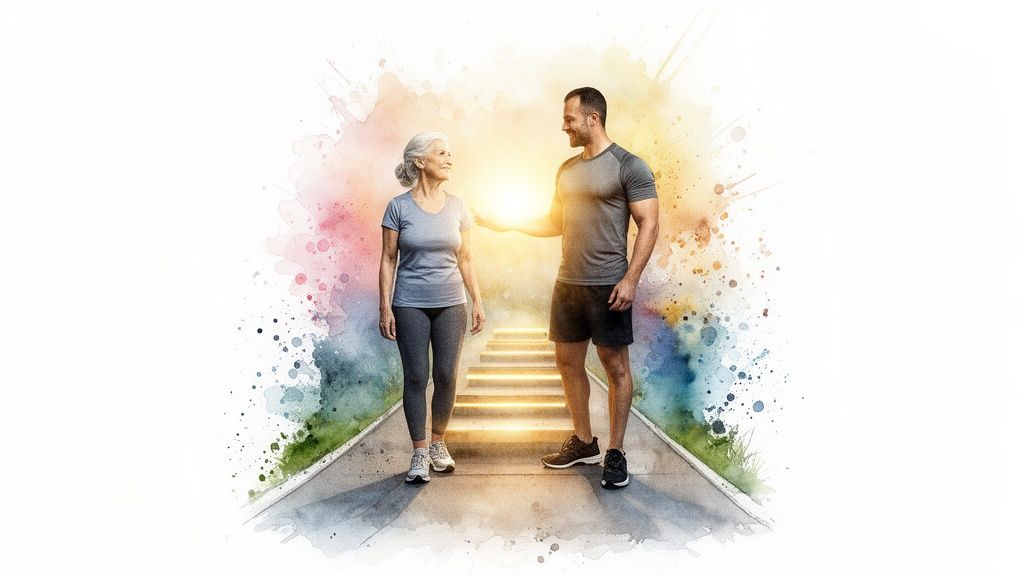
Trying to figure out which exercises are safe for fragile bones is like navigating a tricky, unlit path at night. The risk of a misstep is real. A qualified trainer, in essence, turns on the lights. They illuminate the safest route forward, showing you exactly which movements will build you up while steering you clear of the ones that could cause harm.
But this kind of expert guidance isn’t just about avoiding injury; it’s about actively rebuilding. We know that targeted, weight-bearing exercise sends a powerful signal to your body to strengthen its skeletal frame. A great coach ensures you perform every movement with the right form and intensity to make that happen.
Exercising with Osteoporosis With vs Without a Specialist
Going it alone can feel brave, but the stakes are high. Understanding the difference between a DIY approach and guided training is the first step toward making a smarter, safer choice for your health.
| Factor | Exercising Alone | With a Specialist Trainer |
|---|---|---|
| Safety | High risk of improper form, choosing unsafe exercises, or pushing too hard, which can lead to fractures. | Program is designed to be do-no-harm. Every exercise is selected and modified for bone safety. |
| Effectiveness | Guesswork often leads to doing exercises that are either too gentle to be effective or too aggressive to be safe. | Targeted and progressive. Workouts are designed to create the specific stimulus needed for bone growth. |
| Confidence | Fear and uncertainty can lead to avoiding activity altogether, which accelerates bone loss. | Builds confidence session by session, transforming fear into a sense of empowerment and control. |
| Accountability | It’s easy to skip workouts or give up when you're unsure if what you're doing is even working. | Provides structure, motivation, and expert feedback, keeping you consistent and on track. |
The takeaway is clear: while any movement is better than none, working with a specialist turns exercise from a potential risk into a powerful, bone-building tool.
From Fear to Empowerment
That fear of fractures often creates a dangerous cycle: we become scared to move, so we become less active. Unfortunately, inactivity is one of the fastest ways to accelerate bone loss.
A good trainer helps you break that cycle, one session at a time. They start you off with a solid foundation of safe, manageable exercises. As you get stronger and more comfortable, they progressively increase the challenge.
This structured approach changes everything. Exercise stops being a source of anxiety and becomes an empowering tool for taking back control of your health. You learn what your body is truly capable of, gaining the physical strength to go about your daily life with more ease and much less fear.
The Scientific Backing for Guided Training
The need for this specialized support is undeniable. A 2026 CDC analysis found that 18.8% of women and 4.2% of men over 50 are living with osteoporosis. In response, personal trainers with the right expertise have become critical allies.
One landmark study showed that a well-designed training program—averaging just 2.6 sessions a week for 45 minutes each—significantly boosted strength, flexibility, bone mineral density, and balance in older women with osteoporosis. The best part? It also dramatically slashed their fall risk. Discover more about these important osteoporosis exercise findings.
Working with a professional takes the guesswork out of the equation. Instead of wondering if an exercise is safe or effective, you can focus all your energy on getting stronger, knowing every movement is chosen for your specific needs.
Ultimately, partnering with a personal trainer for osteoporosis is an investment in your long-term independence. It's about building a more resilient body that lets you keep doing the things you love—safely and confidently—for years to come.
The Science of Building Stronger Bones After 50
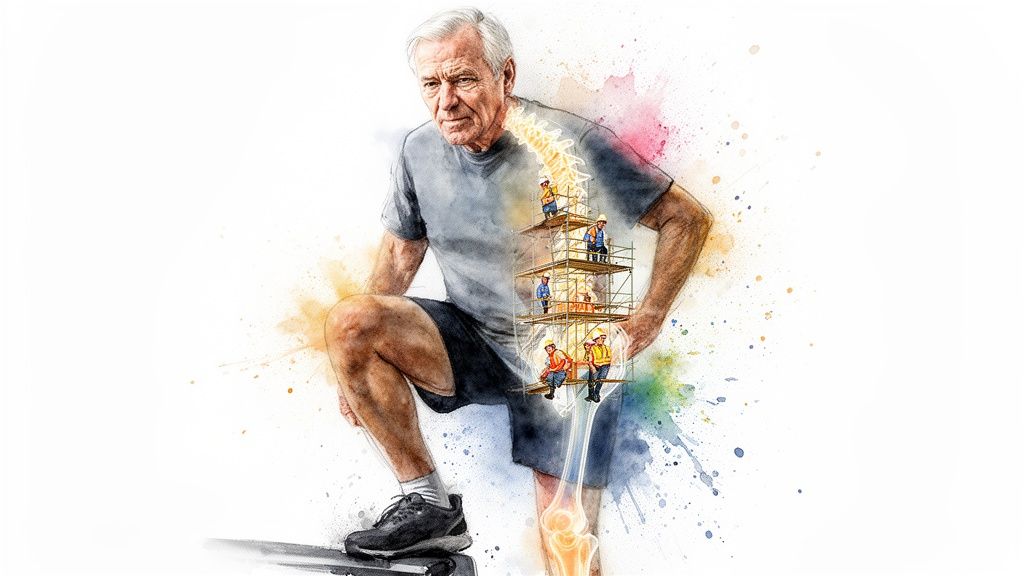
To really get how exercise strengthens bone, think of your skeleton as having its own little construction crew. This crew is made up of two teams: the demolition crew (osteoclasts) that clears out old, tired bone, and the building crew (osteoblasts) that lays down fresh, strong bone. In a healthy body, these two crews work in perfect harmony.
But with osteoporosis, things get out of whack. The demolition team starts working overtime, and the builders just can't keep up. The result? Bones become weaker and more porous over time, making them vulnerable to fractures. The right kind of exercise acts like a good foreman, showing up on site and yelling, "We need more builders, now!"
Wolff’s Law: Your Skeleton’s Foreman
This isn't just a convenient story; it's a core principle of how our bodies work, known as Wolff's Law. Put simply, Wolff's Law says your bones will adapt to the specific stresses you place on them. When you introduce the right kind of stress through exercise, you're sending a loud, clear message to your body: "Hey, we need to reinforce this area!"
It’s a lot like getting calluses on your hands after a weekend of gardening. The repeated stress signals your skin to get tougher. In the exact same way, the mechanical load from weight-bearing exercise signals your bones that they need to increase their density to handle the demand.
Your skeleton isn't some static, concrete structure. It’s a living, dynamic tissue that is constantly remodeling itself based on what you ask it to do. This is why a personal trainer for osteoporosis focuses on applying just the right amount of stress to spark that positive change without causing harm.
This signal is what tells your body to send in more osteoblasts—the builders—to the exact sites being worked. They get busy laying down new bone mineral, literally fortifying your skeleton from the inside out. It's also why just any exercise won't do. The stimulus has to be strong enough to get the foreman's attention.
The Right Formula for Building Bone
So what does it actually take to move the needle on bone density? It really comes down to two things: consistency and the right kind of intensity. The gold-standard approach for combating osteoporosis is clear: progressive resistance training that targets the lower body is proven to be the most effective for increasing bone mineral density (BMD) at the femoral neck, a key area for fracture risk.
In fact, extensive research shows that you need to commit to at least three sessions a week for a full year to see significant, site-specific gains in BMD. One landmark study outlined a powerful formula, revealing that 30-60 minute multicomponent sessions, done three or more times a week for at least 10 months, are necessary for meaningful improvements. You can dig into the full study about these crucial osteoporosis exercise guidelines and its findings.
This research really shines a light on two non-negotiable rules for success:
- Consistency: Hitting the gym once in a while won't cut it. You need regular sessions to keep that bone-building crew on the job.
- Progressive Overload: You have to gradually make things more challenging over time. That could mean lifting a bit heavier, doing a few more reps, or simply improving your form and control.
Turning Your Skeleton into a Resilient Framework
The goal of a smart program isn't just to slow down bone loss—it's to actively build a more resilient skeletal structure. A personal trainer who specializes in osteoporosis knows how to create this stimulus safely. They make sure you’re loading the most critical areas, like your hips and spine, with absolute precision.
For instance, you might start with a simple bodyweight squat, focusing on perfect form. Once that feels solid, your trainer will add a small amount of resistance with dumbbells or a weight vest. This gradual challenge is what keeps your bones from getting complacent. It constantly nudges them to adapt and get stronger.
This methodical approach is what turns a fragile skeleton into a strong, supportive framework. It empowers you to move through your life with more strength, better balance, and the quiet confidence that comes from knowing you’re making your body more durable for all the years ahead.
What a Specialized Osteoporosis Training Program Actually Looks Like
Working with a trainer who understands osteoporosis is nothing like just showing up at the gym and hoping for the best. It’s a completely different experience. You get a plan designed from the ground up where every single movement is chosen for one reason: to build stronger bones without putting you at risk.
This partnership always starts with a detailed initial assessment. Think of it as a fact-finding mission. Your trainer will want to see your medical history, review your bone density (DEXA) scan results, and understand any specific advice from your doctor. They’ll also guide you through a few simple movements to see how you move right now—checking your balance, posture, and current strength.
This first meeting is everything. It tells the trainer exactly where to start, identifies any wobbly movement patterns that need attention, and ensures your program is built for your body from day one. It’s all about creating a safe, effective, and encouraging path forward.
The Structure of a Typical Training Session
While no two sessions are exactly alike, they all follow a proven, three-part structure. Each phase has a distinct job to do: preparing your body, safely stressing your bones to trigger growth, and helping you recover.
- Dynamic Warm-Up: We’re not talking about old-school static stretching here. Instead, you’ll do gentle, flowing movements—things like arm circles, slow leg swings, and easy torso rotations. The goal is to get blood flowing to your muscles and get your joints ready for the work ahead.
- Core Workout: This is the heart of the session. It’s where we focus on smart, powerful compound exercises that safely load the bones in your hips and spine—the areas most vulnerable to fracture. This is the stimulus your body needs.
- Cool-Down and Balance Work: We finish every session by shifting gears. This phase is dedicated to improving your stability to reduce fall risk and calming your system down. Expect targeted balance drills and a few safe, spine-friendly stretches.
This deliberate flow ensures you’re properly warmed up, get the most effective work done, and walk out feeling more stable and confident than when you came in.
Progressive Overload: The Secret to Building Bone
The engine that drives all your progress has a technical-sounding name: progressive overload. It sounds intense, but the concept is actually very simple and gradual. It just means that to get stronger, your body needs a gentle but consistent reason to adapt.
For example, you might start by learning to squat to a chair with perfect form using just your body weight. Once that feels solid, your trainer might add a very light dumbbell. Weeks later, that weight might increase just a little bit.
This carefully managed increase in challenge is the signal that tells your bones, "Hey, we need to get denser and stronger!"
Progressive overload is the engine of change. A good trainer’s job is to be the expert driver—applying just enough gas to move you forward without ever taking a risk. It’s about making you consistently stronger, not just temporarily sore.
This methodical approach keeps you working in that sweet spot: safe, but effective. It builds your confidence right alongside your strength, because you can actually feel yourself becoming more capable, week after week. You can learn more about which exercises deliver the biggest impact in our guide to the best exercises for osteoporosis prevention.
Sample Bone-Building Exercises
A smart osteoporosis program uses a variety of exercises that target key areas. The focus is always on perfect form and keeping your spine in a safe, neutral position—not on lifting heavy. Here are a few examples of what you might do:
- Weighted Lunges: This is a fantastic way to load the hip and leg bones one at a time, which gives you the bonus of challenging your balance.
- Chair Squats: A safe, functional movement that builds strength in your legs and hips by mimicking one of the most important motions in daily life: getting up from a seat.
- Single-Arm Dumbbell Rows: This builds the crucial back muscles that support good posture, all while your trainer ensures your spine stays straight and protected.
- Balance Drills: Simple but powerful exercises like standing on one foot or walking heel-to-toe are essential for training your body to prevent a fall.
Every exercise is hand-picked not just to build muscle, but for its direct, bone-stimulating effect on the areas that need it most. This is what separates a specialized program from a generic workout—and it’s how you get real, lasting results.
Essential Safety Rules for Osteoporosis Workouts
When you’re training with osteoporosis, safety isn't just a suggestion—it’s the absolute first rule of the gym. The wrong moves can set you back, but the right ones, done with perfect technique, are the most powerful tools you have for building a stronger, more resilient body. A trainer who specializes in osteoporosis is your safety expert, guiding you toward results while steering you clear of risk.
Think of your spine like a dry stick. You wouldn’t bend or twist it sharply, because you know it could snap. The same exact logic applies here. The most important rule is to avoid any exercise that rounds your spine forward (flexion) or twists it, especially with weight. These movements put a tremendous amount of compressive force on your vertebrae, which is exactly what we need to prevent.
This is precisely why old-school exercises like sit-ups and crunches are off the table. They force your back into that dangerous rounded shape. Instead, a knowledgeable trainer will teach you how to build a strong, stable core while keeping your spine perfectly straight and protected.
Safe vs Risky Movements for Osteoporosis
To make things simple, I tell my clients to think of exercises as either "green light" or "red light." A good trainer helps you spot the difference instantly, so every single movement you do is a clear green light for building bone.
Here's a quick guide to help you tell the difference:
| Movement Type | Safe (Green Light) Examples | Risky (Red Light) Examples |
|---|---|---|
| Core Strengthening | Planks, Bird-Dog, Pallof Press (maintains a neutral spine) | Sit-ups, Crunches, Russian Twists (forces spinal flexion/twisting) |
| Lower Body | Goblet Squats, Lunges, Hip Hinges (with a flat back) | Deep Squats with a rounded lower back, High-Impact Jumps |
| Upper Body | Dumbbell Rows, Seated Cable Rows (with proud chest) | Overhead Presses with an arched back, certain seated machines that encourage slouching |
| Flexibility | Gentle hip and shoulder stretches, Cat-Cow (controlled) | Toe Touches (from standing), Deep Forward Folds, Aggressive Spinal Twists |
This table isn't about creating fear; it's about building confidence. Once you know the rules of the road, you can move with purpose and stop worrying if you're doing something wrong.
This infographic breaks down the safe and structured approach a specialist trainer will use.
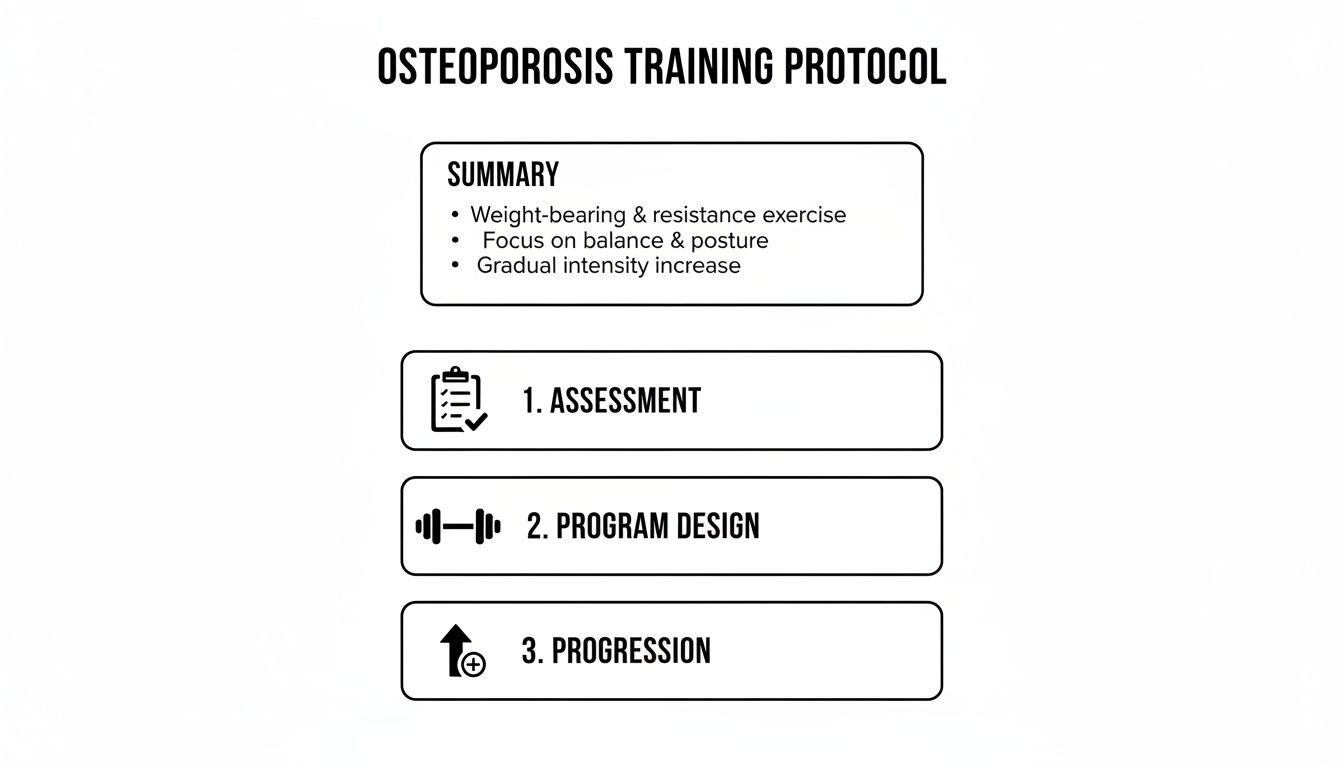
As you can see, a safe plan isn't random. It’s a deliberate three-step process: careful assessment, smart program design, and gradual, intelligent progression.
Knowing the Difference Between Soreness and Pain
It’s absolutely vital to learn to listen to your body. Feeling some muscle soreness a day or two after a workout is normal. It's a good sign, telling you that your muscles are adapting and getting stronger.
But sharp, sudden, or shooting pain is a stop sign. That's not progress; it's your body's alarm system telling you something is wrong. An expert trainer provides instant corrections to your form, but just as importantly, they teach you how to become your own best advocate. You’ll learn to feel the difference between the good ache of progress and the warning signal of pain.
The greatest value of a trainer is having an expert pair of eyes on every single repetition. They provide instant, joint-smart corrections that you might not even realize you need, keeping you safely on the path to stronger bones.
This immediate feedback loop is priceless. It stops you from unknowingly practicing a faulty movement that could lead to injury down the road. For example, using a weighted vest can be fantastic for adding load, but only if your posture stays perfect. Our article on the weight vest benefits for bone density dives deeper into this.
Ultimately, these safety rules are meant to empower you. They give you the knowledge to move with confidence, knowing you are building a more resilient body without taking foolish risks. With a skilled personal trainer for osteoporosis in your corner, exercise becomes a safe, effective, and deeply positive part of your life.
Finding the Right Osteoporosis Personal Trainer for You
When you’re managing osteoporosis, choosing the right person to guide your exercise is probably the single most important decision you’ll make. This isn't the time for a generalist. Not all personal trainers are created equal, especially when it comes to protecting your bones.
You need someone who is more than just a fitness enthusiast. You need an expert with a deep, practical understanding of how a body over 50 works.
Think of it like hiring a specialized craftsman to restore a priceless antique. You wouldn’t trust a general handyman with delicate, irreplaceable work. You’d find a specialist who knows exactly which tools are safe and which techniques will strengthen the structure without causing damage. A personal trainer for osteoporosis is that specialist for your body.
Credentials and Background to Look For
The right qualifications are your first line of defense. A trainer's education tells you they've done the work to understand the science behind safe, effective exercise for bone health.
Here’s what you should be looking for:
- A Solid Educational Foundation: A degree in a field like Kinesiology or Exercise Science is a great sign. It shows a formal, foundational knowledge of how the human body moves.
- Top-Tier Certifications: Look for credentials from nationally respected organizations like the National Academy of Sports Medicine (NASM) or the American Council on Exercise (ACE). These are the industry standard.
- Specialty Training: This is the most critical part. Do they have advanced certifications in senior fitness, medical exercise, or post-rehab training? This is what separates a general trainer from a specialist who can handle your specific needs.
These aren't just letters after a name. They represent a commitment to a higher standard of care and safety.
Key Questions to Ask During a Consultation
Your first meeting is more than a sales pitch—it's an interview. This is your chance to gauge their expertise, see how they communicate, and decide if they're the right guide for you. A true professional will welcome your questions, so don't hold back.
Here are a few essential things to ask:
"Tell me about your experience working with clients who have osteoporosis or low bone density."
Listen for specific examples, not vague assurances. A confident expert will be able to talk you through their approach and the progress they've seen in other clients."What does your initial assessment look like?"
The right answer should involve more than just asking about your goals. They should want to review your medical history, discuss your DEXA scan results (if you have them), and perform a thorough movement screen to assess your balance, posture, and form."How do you protect the spine during exercise?"
This is a big one. Their answer should immediately mention avoiding loaded forward bending (spinal flexion) and aggressive twisting. If they hesitate or can't explain this core safety principle, it's a major red flag."How would you progress my workouts over time?"
Look for a philosophy built on gradual, progressive overload. They should talk about starting slow, mastering form first, and then methodically increasing the challenge in a way that feels safe and manageable.
A great trainer listens more than they talk in that first meeting. Their main goal should be to understand your history, your goals, and your concerns—not to sell you a generic workout package.
Ultimately, this conversation is as much about connection as it is about credentials. You should leave that first meeting feeling heard, confident, and supported. For a deeper dive into what a well-structured program looks like, check out our guide on what a complete personal training workout should include.
Finding a coach who you trust and feel comfortable with is the final, crucial piece of the puzzle.
Frequently Asked Questions About Osteoporosis and Exercise
Starting an exercise program after an osteoporosis diagnosis can feel like walking a tightrope. You know it’s the right thing to do, but you’re worried about making a wrong move. It’s a mix of hope and hesitation we see all the time.
This section tackles the most common questions we hear from our clients. Our goal is to give you clear, straightforward answers so you can move forward with confidence.
Is It Ever Too Late to Start Exercising for Osteoporosis?
Absolutely not. This might be the most persistent myth out there—the idea that after a certain age, your bones are "set in their ways." The reality is, your bones are always in a state of remodeling. It’s never too late to influence that process for the better.
Think of it this way: your body has a "demolition crew" (cells that remove old bone) and a "construction crew" (cells that build new bone). With osteoporosis, the demolition crew has been working overtime. A targeted exercise program is how you get the construction crew back on the job.
Even if you’re starting later in life, research is clear that you can still make a huge difference. While exercise might not completely reverse the condition, it can:
- Slow down bone loss significantly, helping you hold on to the bone density you have.
- Build muscle strength, which acts as a protective frame for your skeleton and makes everyday tasks feel easier.
- Sharpen your balance and coordination, which is your single best defense against falls—the primary cause of fractures.
The trick is starting where you are now. A personal trainer specializing in osteoporosis knows exactly how to create a safe, effective starting point that builds your confidence from day one.
Will Weight-Bearing Exercise Hurt My Joints if I Also Have Arthritis?
This is a fantastic and completely valid question. Many people with osteoporosis also manage osteoarthritis, and the thought of loading joints that already ache seems like a terrible idea.
But here’s the key: a good coach knows the goal is to load the bones, not punish the joints. It’s all about finding smart ways to work around the arthritis while still getting that bone-building signal.
Your body is incredibly adaptable. A good coach knows how to find the perfect middle ground—challenging your bones just enough to trigger growth while respecting the limitations of your joints. It's about working with your body, not against it.
For instance, if you have both osteoporosis and knee arthritis, here’s how a trainer might adjust things:
- Modify the Movement: If a deep squat hurts your knees, we’d switch to a partial squat or a chair squat. You still load the hips and leg bones, but without irritating the joint.
- Choose a Better Tool: Instead of squats, we might use a leg press machine. It strengthens the exact same bones but often with less direct pressure on the knee itself.
- Strengthen the Support System: Building up the muscles around an arthritic joint is like giving it a natural, internal brace. This added stability often reduces pain and improves function.
In many cases, a well-designed strength program doesn't just manage both conditions—it can actually improve arthritis symptoms.
How Quickly Can I Expect to See Results in My Bone Density?
It’s so important to set the right expectations here. You will likely feel stronger, more stable, and more confident within a few months, but seeing a measurable change on your next DEXA scan takes time.
Bone remodeling is a slow biological process. It’s like planting a tree—you don't see it shoot up a foot overnight, but under the surface, it’s building a strong root system. Exercise is what builds that strong root system for your skeleton.
- Short-Term Wins (1-3 Months): You’ll notice the functional improvements first. Carrying groceries feels easier. Your posture feels taller. You feel steadier on your feet. These are the wins that immediately improve your quality of life.
- Long-Term Results (12+ Months): To see a significant, measurable shift in bone mineral density (BMD), you need consistency. Most studies show it takes at least 12 months or more of dedicated training to move the needle on a bone density scan.
This is where having a trainer for accountability is so powerful. They help you stay motivated by celebrating the short-term wins while keeping you on track for the long-term goal: building denser, more resilient bones.
What if My Residential Gym Has Limited Equipment?
This is a common concern, especially for our clients in Streeterville high-rises. The good news? You don't need a gym full of fancy machines to build strong bones. An experienced trainer can design a world-class program with just a few basic tools.
The magic of a bone-building program isn't in the equipment, it’s in the quality of movement and progressive intensity.
A great coach can create an incredibly effective workout using just:
- Dumbbells: The workhorse for squats, lunges, rows, and presses.
- Resistance Bands: Perfect for waking up the muscles in your hips and back.
- Kettlebells: A fantastic tool for building integrated, full-body strength.
- Your Own Body Weight: The foundation of all functional movement.
An expert sees possibilities, not limitations. They can walk into any gym, big or small, and immediately know how to get the job done by focusing on perfect form and safely loading your hips and spine. After all, some of the most powerful bone-building exercises, like a goblet squat or a single-arm row, only require one dumbbell and expert guidance.
Are you a Streeterville resident ready to build stronger bones safely and confidently? Prime Vitality 50+ brings expert, in-building personal training directly to you. Forget the commute and crowded gyms—let's build a stronger, more resilient you, right where you live. Learn more and book your complimentary consultation today at primevitality50plus.com.